Japan launches MMX probe to bring back samples from Mars' moon Phobos
Summary
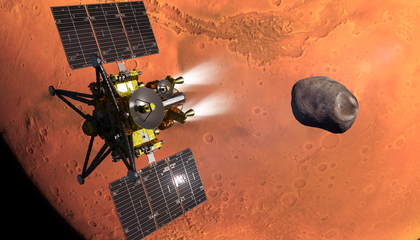
Japan launched the Martian Moons eXploration (MMX) spacecraft on an H3 rocket on Tuesday, in a mission led by the Japan Aerospace Exploration Agency (JAXA). The probe is designed to collect surface material from Phobos, one of Mars's two small moons, and return it to Earth in 2031. Smithsonian Magazine reports it is expected to reach the Martian system in August 2027. Reports differ on the length of the mission: The Japan Times calls it a five-year mission, while Euronews calls it three years. The Japan Times describes it as the first attempt to land on a Martian moon, and Space.com reports it could be the first spacecraft to return to Earth from Mars. Scientists still do not know how Mars acquired its two moons, and the samples could help shed light on the origins of the solar system and life on Earth. ABC News reports the sample is expected to land in Australia once retrieved, and RFI reports that French and German technology is on board.
Timeline
Smithsonian Magazine
Source ↗Reports that JAXA launched a spacecraft expected to reach the Martian system in August 2027 and return samples from Phobos in 2031, and that scientists still do not know how Mars acquired its two moons.
Space.com
Source ↗Reports that Japan launched the MMX sample-return mission to Mars' moons, which could be the first spacecraft to return to Earth from Mars, with samples planned to come back on board.
Scientific American
Source ↗Reports that Japan launched a probe to collect rocks from Mars' moon Phobos, with the Martian Moons eXploration mission aiming to bring back samples from Phobos.
Sky News
Source ↗Reports that Japan launched a spacecraft towards Mars in a ground-breaking mission to bring back samples from the largest of the planet's two moons.
NDTV
Source ↗Reports that a Japanese spacecraft rocketed toward Mars on Tuesday, on a world-first mission to a moon of Mars.
RTÉ
Source ↗Reports that Japanese scientists launched a spacecraft aiming to be the first to retrieve samples from one of Mars's moons, potentially helping to unlock the origins of the Solar System and life on Earth.
ABC News
Source ↗Reports that an international mission aiming to collect sand and rock from one of Mars's moons is expected to land in Australia once the sample is retrieved.
The Japan Times
Source ↗Reports that Japan launched a five-year probe, the first attempt to land on a Martian moon, to collect a sample that could shed light on the origins of the solar system and life on Earth.
RFI
Source ↗Reports that Japan launched a spacecraft to Mars's two small moons carrying French and German technology, with the MMX probe aiming to collect material from Phobos and deliver it to Earth in 2031.
Euronews
Source ↗Reports that Japan's H3 rocket launched the MMX probe on Tuesday, starting a three-year mission to collect samples from Phobos and study the origins of the Solar System.
Phys.org
Source ↗Reports that a Japanese spacecraft rocketed toward Mars on Tuesday on a quest to explore its mysterious moons and bring back samples.
CBC News
Source ↗Reports that a Japanese spacecraft rocketed toward Mars on Tuesday on an unprecedented quest to explore its mysterious moons and bring back samples.
Comments
No comments yet.
to like and comment.